
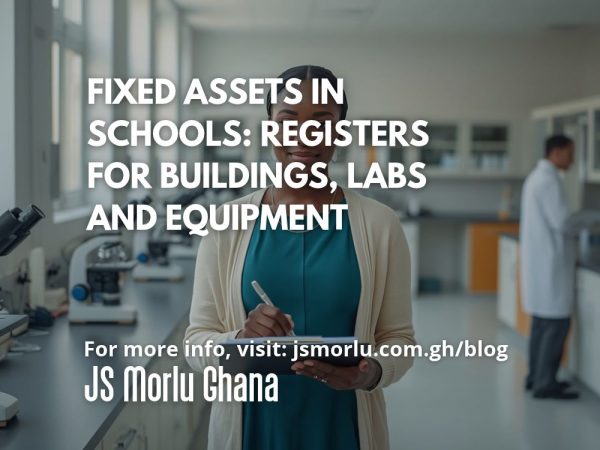
Schools depend on buildings, classrooms, laboratories, computers, furniture, vehicles and other equipment to deliver quality education. These assets support teaching, learning, administration and student welfare. However, acquiring them is only one part of responsible asset management. Schools must also keep accurate records of what they own, where each asset is located, who is responsible for it and what condition it is in.
As schools expand their facilities and invest in new equipment, tracking these resources can become challenging. Some assets are purchased directly, while others are donated by parents, alumni, development partners or corporate sponsors. Equipment may also be transferred between departments, damaged, replaced or disposed of.
Without an organised fixed asset register, management may struggle to establish the actual value of school property or identify items that are missing, underused or in need of maintenance.
For example, a school may have purchased 30 computers for its ICT laboratory several years ago. If there is no reliable record of their purchase, location and condition, management may not know how many are still operational or whether all the computers are accounted for.
A properly maintained fixed asset register helps schools protect their resources, support accurate financial reporting and plan for future maintenance and replacement.
Understanding Fixed Assets in Schools
Fixed assets are physical resources that an organisation holds for use over more than one accounting period. In schools, they are generally acquired to support educational, administrative and operational activities rather than for resale.
Common examples include:
- Buildings and infrastructure: Classrooms, libraries, administration blocks, dormitories, staff accommodation, dining halls and sports facilities.
- Laboratory equipment: Microscopes, testing instruments, laboratory benches, refrigerators and safety equipment.
- ICT equipment: Computers, laptops, printers, projectors, servers and networking equipment.
- Furniture and fittings: Desks, chairs, cupboards, bookshelves and classroom boards.
- Vehicles: School buses, minibuses and utility vehicles.
- Sports equipment: Gymnasium equipment, playground installations and other long-term facilities.
Not every item purchased by a school qualifies as a fixed asset. Stationery, cleaning materials and other supplies consumed during normal operations are generally treated as expenses or inventory, depending on their nature.
Schools should establish a capitalisation threshold in line with their accounting policies. This helps determine whether a purchase should be recorded as a fixed asset or expensed. The distinction is important because incorrect classification can affect the accuracy of the school’s financial statements.
Why Schools Need a Fixed Asset Register
A fixed asset register is a detailed record of an organisation’s property, plant and equipment. It contains financial and operational information about individual assets and provides a basis for monitoring their movement, condition and value.
For schools, it serves several important purposes.
1. Knowing What the School Owns
Schools may accumulate assets over many years through purchases, donations and construction projects. Without a central record, it becomes difficult to establish the full range of resources available.
For example, a school with several science laboratories needs to know how many microscopes, refrigerators and other equipment it owns. A register helps management identify these items and their locations, reducing the risk of unnecessary purchases.
2. Protecting School Property
Computers, projectors, laboratory equipment and vehicles represent significant investments. Some are also easily moved or removed without authorisation.
Assigning identification numbers and custodians helps management establish responsibility for these resources. If a projector is assigned to a particular department, for instance, the department can be held responsible for monitoring its use and condition.
3. Supporting Accurate Financial Reporting
Fixed assets form part of a school’s financial position. Their purchase costs, depreciation, impairment and disposal values affect the financial statements.
A complete register helps the finance department calculate asset balances and reconcile them with the general ledger. Without reliable records, the school may report values that do not reflect the assets it actually owns or controls.
4. Planning Maintenance and Replacement
Buildings require repairs, computers become outdated and laboratory equipment needs servicing. Recording acquisition dates, useful lives and asset conditions helps management anticipate these requirements.
This allows schools to plan maintenance and replacement expenditure instead of waiting for equipment to fail or facilities to become unsuitable for use.
What Should a School’s Fixed Asset Register Contain?
A fixed asset register should provide enough information to identify each asset, establish its financial value and monitor its location and condition.
Important details include:
- Asset identification number: A unique reference assigned to each asset.
- Description and category: The asset’s name, specifications and classification, such as building, laboratory equipment or furniture.
- Acquisition date: When the asset was purchased, constructed or received.
- Acquisition cost or recognised value: The amount recorded when the asset was initially recognised.
- Supplier or donor: The party from whom the asset was acquired.
- Funding source: Whether it was purchased using school funds, donor funding or a grant.
- Location: The campus, classroom, laboratory, office or other area where the asset is kept.
- Custodian: The department or staff member responsible for it.
- Serial number: Manufacturer details or another identifying reference, where available.
- Useful life and depreciation: The period over which the asset is expected to be used and the method applied to calculate depreciation.
- Condition and status: Whether the asset is operational, damaged, under repair or obsolete.
- Disposal details: The date, reason and approval for any asset sold, scrapped or otherwise disposed of.
For example, a computer in the ICT laboratory should have an identification number, serial number, acquisition details and assigned location. Recording only the total number of computers in the laboratory may not be sufficient to identify missing or transferred equipment.
Managing Different Categories of School Assets
Different assets require different levels of monitoring because of their value, use and maintenance requirements.
1. Buildings and Infrastructure
Buildings are often among the most valuable assets owned or controlled by a school. They may include classroom blocks, libraries, administration offices, dormitories, staff accommodation and sports facilities.
The register should identify each building and record its location, acquisition or completion date, cost, use and condition. Supporting documents may include land title documents, construction contracts, building plans and completion certificates.
Schools should distinguish between land and buildings in their accounting records. Under IAS 16, Property, Plant and Equipment, land and buildings are accounted for separately, even when acquired together. Land generally has an unlimited useful life and is not depreciated, while buildings are normally depreciated over their estimated useful lives.
This distinction helps ensure that asset values and depreciation charges are properly reported.
2. Laboratories and Scientific Equipment
Laboratories contain specialised equipment that may be expensive and sensitive to handling conditions. Examples include microscopes, weighing scales, laboratory ovens, refrigerators and testing instruments.
Schools should record the location, identification number and custodian of each significant item. Maintenance and calibration dates should also be monitored where relevant.
For example, a microscope may still be physically present but may no longer provide reliable results because it has not been properly maintained. Recording its condition helps management identify equipment that requires servicing or replacement.
3. ICT Equipment
Computers, laptops, printers, projectors and networking equipment are frequently moved between classrooms, offices and departments.
The register should record serial numbers, asset tags, assigned users and current locations. Transfers should be approved and documented so that the finance department can update the records.
Schools should also maintain relevant warranty, maintenance and software licence information. This helps protect technology investments and supports timely repairs and replacements.
4. Furniture and Other Equipment
Classroom desks, chairs, office furniture, cupboards and library shelves may appear inexpensive individually, but their combined value can be substantial.
Schools should record these assets by category and location. Higher-value or easily movable items may require individual identification numbers.
Periodic inspections can help identify damaged furniture, missing items and equipment that should be repaired or replaced.
Accounting for Fixed Assets Under IAS 16
For schools applying IFRS, IAS 16 provides guidance on recognising, measuring and reporting property, plant and equipment.
An item is generally recognised as an asset when it is probable that future economic benefits associated with it will flow to the organisation and its cost can be measured reliably.
Initial Measurement
An asset is initially measured at cost. This generally includes its purchase price and costs directly attributable to bringing it to the location and condition necessary for its intended use.
For example, the cost of laboratory equipment may include the purchase price and qualifying delivery and installation costs.
Routine maintenance, ordinary staff training and general administrative expenses should not automatically be added to the asset’s cost. Correct initial measurement is important because it affects the asset balance and future depreciation.
Depreciation
Depreciation allocates an asset’s depreciable amount over its useful life.
For example, if a school purchases computers for GH₵120,000 and estimates that they will be used for four years with no residual value, the annual depreciation charge using the straight-line method would be GH₵30,000, assuming the computers are available for use for the full year.
Depreciation is an accounting expense, not a new cash payment. It reflects the consumption of the asset’s service potential over time.
Schools should use reasonable useful lives and depreciation methods based on how assets are expected to be used. These estimates should be reviewed when required by the applicable accounting framework.
Repairs, Improvements and Disposal
Routine repairs, such as fixing a leaking tap or servicing an air conditioner, are generally recognised as expenses when incurred.
However, significant improvements that increase an asset’s service potential or extend its useful life may qualify for capitalisation if they meet the relevant recognition criteria.
When an asset is sold, scrapped or otherwise disposed of, the register and accounting records should be updated. Keeping disposed assets in the register can overstate the school’s reported assets.
How Schools Should Maintain the Register
A fixed asset register is only useful when it reflects the assets the school actually owns or controls. It should therefore be updated whenever an asset is acquired, transferred, damaged or disposed of.
1. Record Purchases and Donations Promptly
Every newly acquired asset should be recorded with its supporting documents. This includes assets purchased directly and those received through donations.
Donated assets should not be ignored simply because the school did not pay for them. Their recognition and measurement should follow the applicable accounting framework. Donation letters and handover documents should be retained as evidence of their source.
2. Assign Identification Numbers
Each significant asset should receive a unique identification number. This may be displayed using a durable label or another suitable method.
A consistent numbering system makes it easier to identify individual items during physical inspections and investigations.
3. Record Transfers Between Departments
When equipment moves from one classroom, laboratory, office or campus to another, the register should be updated.
The transfer record should identify the asset, previous location, new location, date and responsible officers. This reduces the risk of equipment being reported as missing simply because it was moved without updating the records.
4. Conduct Physical Verification
Schools should periodically inspect their assets and compare the physical items with the fixed asset register.
The exercise should identify missing assets, unrecorded items, incorrect location details, damaged equipment and assets that are no longer in use.
For schools in Ghana, the Ministry of Education’s published school fund utilisation guidelines include procedures relating to fixed asset registration, identification, movement and periodic stocktaking. Schools should follow the requirements applicable to their category.
Physical verification is important because an accurate accounting balance does not automatically prove that the assets still exist or are being used appropriately.
5. Control Asset Disposal
Assets should not be sold, scrapped, transferred or donated without the required approval.
For example, if a school disposes of obsolete computers, management should retain the disposal approval and supporting records, update the register and ensure that the accounting entries reflect the transaction.
This helps prevent unauthorised disposal and keeps the school’s financial records accurate.
Common Fixed Asset Management Challenges in Schools
Several weaknesses can affect the accuracy of school asset records.
- Incomplete registers: Basic lists may contain asset descriptions and locations but omit acquisition costs, useful lives and depreciation details.
- Unrecorded donations: Equipment received from alumni, parents and development partners may be overlooked because no payment was made.
- Unrecorded transfers: Assets moved between departments or campuses may not be reflected in the register.
- Poor identification: Without unique numbers or labels, distinguishing between similar items becomes difficult.
- Irregular stocktaking: Missing, damaged or obsolete items may remain undiscovered when physical verification is neglected.
- Incorrect depreciation: Inappropriate useful lives or calculation errors can distort the values reported in the financial statements.
- Unclear responsibility: When no department or staff member is responsible for monitoring an asset, maintenance and accountability may be overlooked.
Addressing these challenges requires cooperation between school management, finance, procurement and department heads.
The Role of Digital Systems in Fixed Asset Management
Maintaining asset records through manual spreadsheets can become difficult as a school acquires more buildings, equipment and other resources. Information may be duplicated, depreciation calculations may contain errors and asset transfers may not be updated promptly.
Digital systems can help schools organise financial information, monitor expenses and improve reporting.
A suitable fixed asset management system should support asset identification, categorisation, acquisition details, location tracking, depreciation calculations, transfers and disposals.
FinovatePro is a cloud-based accounting and financial management platform that supports transaction recording, expense tracking and financial reporting. It can help schools organise accounting information and review their financial performance.
Schools should assess whether their chosen accounting platform also provides the detailed fixed asset register and physical asset tracking functions they require. Where these features are not available, a dedicated asset management system or supplementary register may be necessary.
The important consideration is ensuring that asset records are properly connected to the accounting records. This helps finance teams maintain accurate financial information and gives management a clearer view of the school’s resources.
Conclusion: Protecting School Assets Through Better Record Management
Buildings, laboratories, computers, furniture and other equipment represent important investments in a school’s ability to provide quality education. Managing these resources requires more than recording their purchase costs. Schools must know what they own, where assets are located, who is responsible for them and what condition they are in.
A properly maintained fixed asset register supports financial reporting, improves accountability, assists with maintenance planning and helps management make informed decisions about future purchases and replacements.
Schools should record purchases and donations promptly, assign identification numbers, document asset movements, conduct regular physical verification and maintain appropriate disposal procedures.
For schools in Ghana, it is also important to consider the applicable Ministry of Education and public-sector asset management requirements alongside the accounting framework relevant to the institution.
Ultimately, effective fixed asset management helps schools protect the resources entrusted to them and direct more attention and funding towards their educational responsibilities.
For schools seeking to improve the organisation of their accounting records, expense tracking and financial reporting, FinovatePro can support day-to-day financial management.
Book a FinovatePro demo to explore how the platform can support your school’s accounting and financial management processes.