
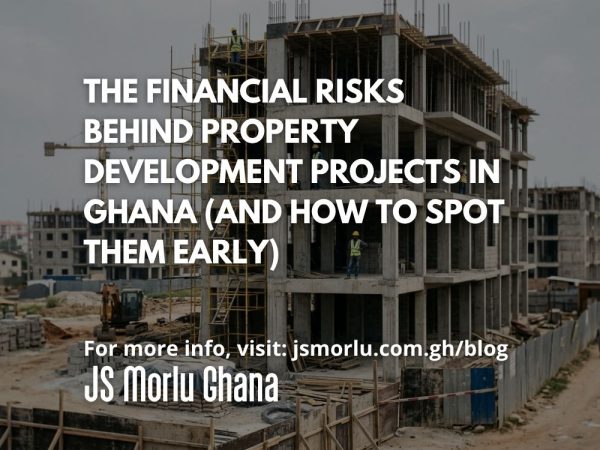
Property development in Ghana has, over the past two decades, attracted growing interest from local developers, diaspora investors, and institutional capital. The country’s expanding urban population, housing deficit estimated in the millions of units, and a growing middle class make the sector look compelling on paper.
Yet projects fail or significantly underperform with striking regularity. Buildings stall mid-construction. Cost projections are routinely exceeded. Pre-sold units go undelivered. Investors lose capital. And in many cases, the warning signs were present long before the financial damage became visible.
This article identifies the most significant financial risks in Ghana’s property development sector and explains how to spot them before they escalate into losses.
Cash Flow Risks: The Structural Vulnerability of Most Projects
The Pre-Sale Dependency Trap
Many Ghanaian developers fund construction primarily through off-plan sales collecting deposits and staged payments from buyers before or during construction. This model places enormous strain on cash flow management: if sales slow down, payment collections fall behind schedule, or buyers default, the entire funding structure can collapse.
The risk intensifies when the developer has limited working capital reserves, has entered fixed-price construction contracts that cannot be delayed, or has already committed to financing obligations with lenders or equity partners.
Delayed Revenue Recognition
Where construction timelines are extended which, in Ghana, is more the rule than the exception revenue from unit sales is deferred. But overhead costs, finance charges, and contractor payments continue accruing. The growing gap between outflows and inflows is the root cause of the majority of stalled development projects in the country.
Cost Overrun Risks: Why the Budget Never Survives
Inflation and Currency Exposure
Ghana has experienced significant cedi depreciation and periodic inflation spikes over the past decade. Most construction materials steel, cement, electrical fittings, fittings for MEP systems are either imported or priced in dollars. A project budgeted in cedis at the project inception date may face materially higher costs twelve to eighteen months into construction, with no mechanism for recovery.
Developers who do not explicitly model foreign exchange scenarios into their feasibility studies are effectively building with an incomplete picture of their cost exposure.
Scope Changes and Contractual Weaknesses
In many Ghanaian developments, construction contracts are poorly drafted, lump-sum pricing is not properly enforced, and variation orders are issued informally. Each change order adds cost and time. Without a robust contract administration process, variations accumulate quietly until the final account reveals an overrun that the project can no longer absorb.
Inadequate Contingency Provisions
Industry best practice suggests a contingency of 10–15% of total hard costs for development projects in markets with significant uncertainty. Many Ghanaian feasibility studies either exclude contingency entirely or include a nominal 3–5% figure that bears no relationship to actual risk exposure. When unforeseen costs materialise and they always do there is no buffer.
Governance and Oversight Risks
Weak Financial Controls at Project Level
Property development projects are, in essence, temporary businesses. They require dedicated financial management separate bank accounts, clear approval hierarchies for expenditure, and regular reconciliation between budget and actual costs. In practice, many Ghanaian developers particularly smaller and mid-scale operators co-mingle project funds with general business accounts, making it impossible to accurately track project financial performance in real time.
This creates a situation where the developer discovers the project is in financial distress only when cash runs out, rather than when the first warning indicators appear in the numbers.
Absence of Independent Financial Oversight
Investors and off-plan buyers rarely have access to audited project accounts, independent quantity surveyor reports, or third-party draw-down monitoring. Without these safeguards, funds can be misapplied, redirected to other projects, or simply lost to inefficiency with no accountability mechanism in place.
How to Spot Financial Risks Early: A Practical Framework
- Request and scrutinise the detailed feasibility study not just the headline returns. Look specifically at cash flow timing, debt service coverage, and sensitivity to cost and sales price changes.
- Review the construction contract: confirm lump-sum pricing, variation order procedures, and liquidated damages for delay.
- Assess the developer’s track record: completed projects are a stronger signal than planned projects.
- Verify that project funds are held in a segregated escrow or trust account, not commingled with the developer’s operating accounts.
- Confirm that an independent quantity surveyor will certify payment applications before contractor draws are approved.
- Test the project’s financial resilience: what happens if construction costs increase by 20%? If the cedi depreciates by 15%? If only 60% of units are pre-sold by completion?
Conclusion
The financial risks in Ghana’s property development sector are real, well-documented, and critically identifiable in advance. The developers and investors who succeed are typically those who invest time in rigorous pre-investment analysis, insist on governance structures that provide real-time financial visibility, and build enough financial resilience into their projects to absorb the unexpected.
A project that looks profitable on a spreadsheet but has no contingency, no clear cash flow management plan, and weak contract structures is not a good investment regardless of how attractive the location or the concept may appear.