
By: Bernard Bempong, CA
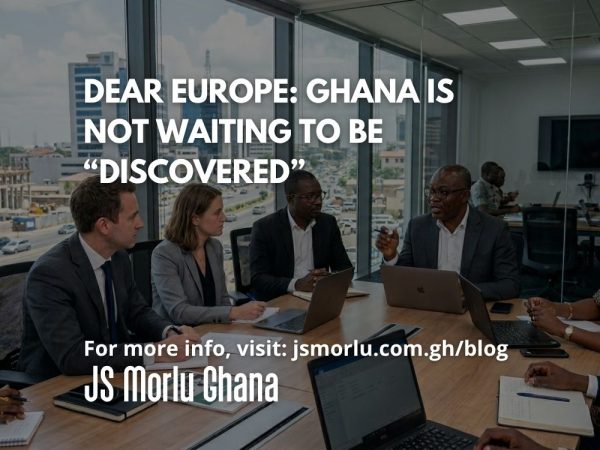
The Real Business Guide for European Companies Entering Ghana
Many European companies arrive in Ghana with:
- polished presentations,
- expansion strategies,
- regional growth targets,
- and enough confidence to power an airport terminal.
Then three months later they are:
- trapped in Accra traffic,
- renegotiating delivery timelines,
- trying to understand mobile money,
- waiting for approvals,
- and emotionally recovering from their first audit season.
Welcome to Ghana.
A country that can:
- frustrate you,
- surprise you,
- humble you,
- inspire you,
- and make you profitable…
sometimes all in the same week.
The companies that succeed here are usually not the biggest.
They are the most adaptable.
Ghana Is Not Europe With Better Weather
This is the first lesson many foreign companies learn.
You cannot simply:
- copy your European operating model,
- import your workflows,
- translate your manuals,
- and expect immediate success.
Because Ghana operates differently.
Not worse.
Differently.
Business here moves through a unique combination of:
- relationships,
- resilience,
- flexibility,
- entrepreneurship,
- digital adaptation,
- and operational improvisation.
Companies that resist this reality usually struggle.
Companies that understand it often thrive.
Relationships Matter More Than You Think
In many European markets, systems dominate.
In Ghana, relationships still matter enormously.
Trust matters.
Reputation matters.
Responsiveness matters.
Business often moves faster through:
- strong relationships,
- local credibility,
- and trusted networks
than through formal structures alone.
Some foreign companies interpret this incorrectly as inefficiency.
It is not.
It is a relationship-based operating culture built through decades of navigating complexity.
The smartest companies respect this immediately.
Ghanaian Consumers Are Smarter Than Many Companies Expect
One dangerous mistake some foreign firms make:
Assuming African consumers are passive markets waiting for foreign expertise.
That assumption fails quickly.
Ghanaian consumers are:
- digitally aware,
- price-sensitive,
- highly adaptive,
- socially connected,
- and increasingly quality-conscious.
They compare prices quickly.
They share customer experiences publicly.
They adopt technology rapidly.
And they can detect corporate arrogance almost immediately.
Respect the market.
It is more sophisticated than many outsiders realize.
Mobile Money Is the Economy
This part cannot be overstated.
If your business strategy does not fully understand mobile money, you are already behind.
In Ghana:
- people buy with mobile money,
- businesses operate through mobile money,
- salaries move digitally,
- and commerce increasingly flows through phones.
Some European companies still approach digital payments cautiously.
Ghana moved aggressively.
Fast.
This shift transformed:
- retail,
- logistics,
- banking,
- SMEs,
- e-commerce,
- and customer expectations.
Understanding this ecosystem is essential.
Infrastructure Will Test Your Emotional Stability
Let us speak honestly.
Doing business in Ghana requires operational resilience.
You must prepare for:
- traffic,
- power interruptions,
- internet instability,
- logistics unpredictability,
- flooding,
- and occasional bureaucratic delays.
The companies that succeed do not complain constantly about these realities.
They plan around them intelligently.
That means:
- backup systems,
- realistic timelines,
- strong local teams,
- operational flexibility,
- and business continuity planning.
Hope is not infrastructure.
Preparation is.
Ghana Is Extremely Entrepreneurial
This is one of Ghana’s greatest strengths.
People here are constantly:
- building,
- trading,
- adapting,
- negotiating,
- and creating opportunity.
That entrepreneurial energy creates enormous business potential.
It also means competition moves quickly.
A foreign company may spend:
- six months analyzing strategy,
- building reports,
- and waiting for approvals.
Meanwhile a local entrepreneur already launched operations from:
- WhatsApp,
- mobile money,
- and one delivery van.
Do not underestimate speed.
The Wrong Local Partner Can Destroy Everything
Many foreign companies fail because they rush partnerships.
They choose:
- politically connected individuals,
- socially impressive personalities,
- or “somebody who knows everybody.”
Then later discover:
- weak operational discipline,
- poor governance,
- financial confusion,
- or reputational risk.
Choose partners carefully.
Good local partners bring:
- operational intelligence,
- credibility,
- market understanding,
- and execution strength.
Bad ones bring:
- excuses,
- chaos,
- and emergency board meetings.
Governance Still Matters
Some companies overcorrect after entering Ghana.
They become too informal operationally.
Suddenly:
- approvals disappear,
- controls weaken,
- documentation becomes inconsistent,
- and WhatsApp becomes the accounting department.
That is dangerous.
The best businesses balance:
- local flexibility,
- operational discipline,
- governance,
- accountability,
- and strong systems.
Because growth without controls eventually becomes expensive confusion.
Customer Service Can Make or Break You
Many companies focus heavily on:
- branding,
- pricing,
- and expansion.
But customers remember:
- responsiveness,
- professionalism,
- and reliability.
If customers pay and suddenly nobody answers calls anymore, trust disappears quickly.
In Ghana, word-of-mouth still matters enormously.
One bad customer experience can travel across:
- WhatsApp groups,
- social circles,
- online reviews,
- and entire business communities very fast.
Ghana Rewards Long-Term Thinkers
The companies that win long-term usually:
- invest patiently,
- build trust,
- strengthen systems,
- hire strong local talent,
- and adapt continuously.
They do not enter Ghana looking only for:
- quick extraction,
- fast profit,
- or short-term opportunity.
They build presence.
That mindset compounds over time.
Because Ghana is evolving rapidly through:
- fintech growth,
- digital commerce,
- entrepreneurship,
- infrastructure development,
- and regional trade expansion.
The long-term opportunities remain enormous.
Final Thought
Ghana is not a market to “figure out” in one PowerPoint presentation.
It is a living business environment requiring:
- humility,
- operational intelligence,
- patience,
- flexibility,
- and strong execution.
The companies that succeed here are usually not the ones with the biggest budgets.
They are the ones willing to:
- listen,
- adapt,
- respect local realities,
- and build intelligently for the long-term.
Because eventually every successful European company in Ghana learns the same lesson:
You do not win Ghana by trying to make it Europe.
You win Ghana by understanding Ghana properly.
And once you do…
the opportunities become extraordinary.
Author: Bernard Bempong is a Chartered Accountant and business advisory leader with over 14 years of experience in audit, taxation, financial management, operational strategy, and business advisory services. As Managing Director of JS Morlu Ghana, he advises international and local organizations on operational efficiency, governance, tax strategy, risk management, and sustainable business growth across multiple industries in Ghana and West Africa.