
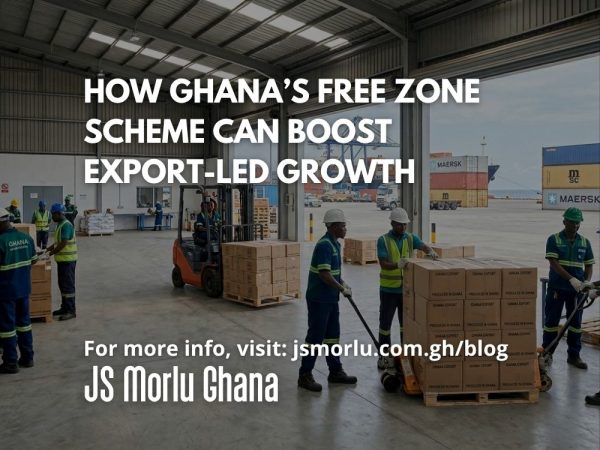
On the outskirts of Tema, a small manufacturing company begins its day before sunrise. Containers are loaded, quality checks are completed, and paperwork is prepared for shipment. The goal is simple but demanding: get products out of Ghana and into international markets on time, at the right cost, and at the right standard.
For many businesses operating in Ghana, this journey is often slowed by production costs, import duties, financing constraints, and regulatory delays. But for firms operating within a structured export environment like the Ghana Free Zones Authority Scheme, the path to global markets is significantly different.
This difference is at the heart of how Free Zones can strengthen export-led growth in Ghana.
Understanding Ghana’s Free Zone Scheme
The Free Zone Scheme is a policy framework designed to encourage the production of goods and services primarily for export. It allows qualifying companies to operate under a regulated environment that offers trade and tax incentives while ensuring compliance with national and international standards.
Typical features include:
- Duty-free import of raw materials and equipment
- Tax incentives during defined operational periods
- Simplified export and import procedures
- Permission to operate within designated industrial enclaves
- Access to foreign markets with fewer administrative barriers
The objective is not just to attract businesses, but to build a strong base for export-oriented industrialization.
How the Free Zone Scheme Drives Export-Led Growth
Export-led growth depends on a country’s ability to produce competitively, scale efficiently, and sustain consistent access to international markets. Ghana’s Free Zone Scheme contributes to this in several important ways.
1. Reducing the Cost of Production for Exporters
One of the most immediate advantages of the Free Zone framework is the reduction in production costs.
By removing or reducing:
- Import duties on raw materials
- Taxes on export-oriented production
- Administrative delays in customs clearance
Businesses are able to lower their overall cost base. This allows Ghanaian products to be more competitive in international markets where pricing is a key factor in trade decisions.
2. Attracting Foreign Direct Investment (FDI)
Export-oriented investors often look for locations that offer cost efficiency, policy stability, and access to regional markets. The Free Zone Scheme provides this by:
- Allowing full foreign ownership in many cases
- Offering predictable regulatory structures
- Reducing entry barriers for manufacturing and processing industries
This has contributed to increased investment in sectors such as agro-processing, textiles, pharmaceuticals, and light manufacturing.
FDI not only brings capital but also introduces new technologies, management practices, and global market access.
3. Encouraging Industrial Diversification
Ghana’s export base has traditionally relied on commodities such as cocoa, gold, and oil. While important, these sectors expose the economy to global price volatility.
Free Zones help diversify exports by promoting:
- Agro-processing industries (cashew, mango, shea, cocoa derivatives)
- Garments and textiles manufacturing
- Pharmaceuticals and chemical production
- Business process outsourcing and ICT services
This diversification strengthens economic resilience and reduces dependence on raw commodity exports.
4. Creating Employment and Skills Development Opportunities
Export-oriented industries tend to be labour-intensive, particularly in manufacturing and processing. As Free Zone enterprises expand, they create:
- Direct employment in production and operations
- Indirect jobs in logistics, packaging, and services
- Skills development in technical and industrial roles
Over time, this builds a more skilled workforce capable of supporting advanced industrial activity.
5. Improving Ghana’s Trade Competitiveness
For countries competing in global markets, competitiveness is not only about production capacity but also about reliability and efficiency. The Free Zone Scheme improves competitiveness by:
- Reducing delays in export processing
- Encouraging compliance with international standards
- Supporting consistent production for global buyers
This strengthens Ghana’s position as a credible trade partner in regional and international markets.
6. Strengthening Foreign Exchange Earnings
Export-led growth directly contributes to foreign exchange inflows. As Free Zone companies export more goods and services:
- The country earns more foreign currency
- Pressure on the local currency is reduced
- National reserves are strengthened
This has broader macroeconomic benefits, including improved economic stability.
7. Building an Export-Oriented Business Ecosystem Beyond individual companies, Free Zones contribute to the development of an ecosystem that supports exports. This includes:
- Logistics and shipping services
- Packaging and warehousing industries
- Financial services supporting trade
- Supplier networks linked to export production
Over time, this ecosystem creates multiplier effects that extend beyond Free Zone enclaves.
Challenges That Must Be Addressed
Despite its advantages, the scheme’s full potential is sometimes constrained by:
- Infrastructure limitations in industrial zones
- Administrative bottlenecks in logistics and clearance processes
- Limited integration of local SMEs into export supply chains
- Capacity gaps in industrial skills and technology adoption
Addressing these challenges is key to maximizing export-led growth outcomes.
Conclusion
Ghana’s Free Zone Scheme is more than a policy incentive structure, it is a platform for transforming how the country participates in global trade. By lowering production costs, attracting investment, diversifying exports, and strengthening industrial capacity, it plays a critical role in driving export-led growth.
However, its long-term impact depends on how effectively businesses, policymakers, and supporting institutions work together to build a competitive and sustainable export ecosystem.