
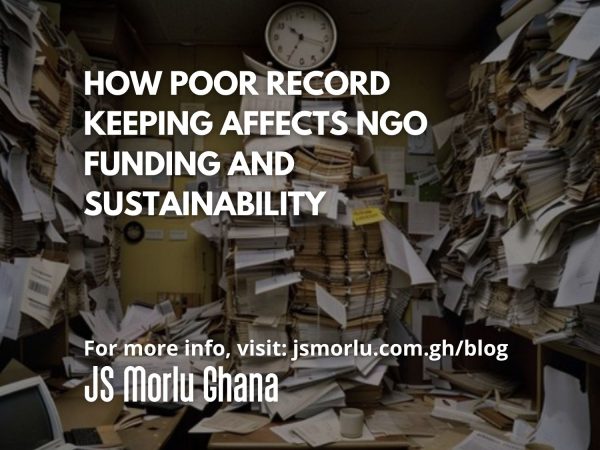
How Poor Record Keeping Affects NGO Funding and Sustainability: Risks, Donor Confidence, and Audit Readiness Explained
Why Record Keeping Determines Organisational Survival
In NGOs and development organizations, record keeping is often treated as a back-office administrative task. In reality, it is one of the strongest indicators of governance strength, financial integrity, and institutional reliability.
In Ghana and across emerging markets, NGOs depend heavily on donor funding, grants, and development partnerships. These relationships are built on trust, and trust is reinforced through documentation. When records are weak, incomplete, or inconsistent, it becomes difficult for donors, auditors, and regulators to verify how funds are managed and what outcomes are achieved.
Over time, this does not remain an administrative issue it becomes a funding and sustainability risk.
Understanding Record Keeping in NGOs: Beyond Filing Documents
Record keeping in NGOs refers to the structured process of capturing, organizing, and maintaining financial and operational information that supports accountability and transparency.
It typically includes:
- Financial records such as ledgers, journals, and bank reconciliations
- Supporting documents such as receipts, invoices, and payment approvals
- Programmatic data such as activity reports and beneficiary records
- Compliance documentation such as donor agreements and audit reports
When these elements are not properly maintained, organizations lose the ability to clearly demonstrate how funds are used and what results have been achieved.
This creates uncertainty for stakeholders who expect clarity, consistency, and traceability in financial reporting.
How Poor Record Keeping Undermines NGO Funding Stability
1. Declining Donor Trust and Funding Confidence
Donors require evidence that funds are used efficiently and for intended purposes. Weak documentation makes it difficult to validate expenditures or confirm alignment with project objectives.
This leads to hesitation in releasing additional funds, delays in approvals, or stricter funding conditions.
Over time, organizations may find themselves excluded from competitive grant opportunities, not necessarily due to poor performance, but due to weak financial evidence systems.
2. Increased Audit Risks and Negative Audit Opinions
Audits depend on verifiable documentation. When records are missing or poorly maintained, auditors are unable to confirm whether transactions are legitimate or properly recorded.
Common issues include:
- Unsupported expenditures
- Missing receipts or approvals
- Weak procurement documentation
- Inconsistent financial reporting
These gaps often result in qualified audit opinions or disclaimers, which signal weaknesses in financial governance.
Such outcomes directly influence donor perception and future funding decisions.
3. Non-Compliance with Donor and Regulatory Requirements
Most donor agreements include strict reporting timelines and documentation standards. Regulatory frameworks also require NGOs to maintain accurate financial records.
When documentation systems are weak, compliance becomes inconsistent, leading to reporting delays or incomplete submissions.
This can result in funding restrictions, penalties, or increased monitoring requirements that reduce operational flexibility.
4. Weak Internal Controls and Increased Financial Risk
Poor record keeping is often a symptom of broader weaknesses in internal control systems. Without proper documentation, it becomes difficult to track spending, verify approvals, or monitor budgets effectively.
This increases exposure to:
- Duplicate or unauthorized payments
- Misclassified expenses
- Budget overruns going unnoticed
- Reduced oversight of project funds
Even when there is no intentional fraud, weak systems create environments where financial inefficiencies can grow undetected.
5. Reduced Ability to Demonstrate Impact and Organisational Learning
Records are not only financial tools they are also evidence of program performance and impact.
Without reliable data, NGOs struggle to evaluate project effectiveness, learn from past interventions, or demonstrate results to stakeholders.
This weakens long-term strategic planning and reduces competitiveness in future funding cycles where results-based reporting is increasingly required.
How Poor Documentation Affects Donor Confidence
Donor confidence is built on three expectations:
- Clear visibility of how funds are used
- Assurance that approvals and processes are properly followed
- Evidence that results match reported activities
When documentation is weak, these expectations are not fully met. Even if programs are impactful, the inability to prove it through records creates doubt.
In funding environments where many organisations compete for limited resources, administrative strength often influences decisions as much as program effectiveness.
Understanding the NGO Audit Process in Simple Terms
Audits are designed to assess whether financial records fairly reflect how funds are managed and whether they comply with agreed standards.
1. Planning and Risk Assessment
Auditors evaluate the organisation’s systems and identify potential risk areas.
Weak documentation immediately increases the perceived level of audit risk, leading to more detailed examination.
2. Evidence Collection and Review
Auditors request financial statements, receipts, bank records, and supporting documentation.
Missing or incomplete records at this stage create gaps that cannot be easily resolved later.
3. Transaction Testing
Selected transactions are reviewed to confirm accuracy, authorization, and compliance.
Even small inconsistencies can indicate broader systemic weaknesses.
4. Audit Reporting and Opinion
Findings are summarised in an audit report, which may result in:
- Unqualified opinion (clean)
- Qualified opinion
- Adverse opinion
- Disclaimer of opinion
The strength of documentation significantly influences the final outcome.
Preparing NGOs for Audits: Practical Governance Practices
Maintain Organized and Centralized Records
All financial and program documents should be systematically filed and easily retrievable.
This reduces audit delays and strengthens transparency during reviews.
Conduct Regular Bank and Ledger Reconciliations
Monthly reconciliations ensure that financial records match actual bank balances and transactions.
This helps detect discrepancies early before they accumulate.
Enforce Proper Approval Controls
All payments and expenditures should be supported by documented approvals.
This strengthens accountability and reduces the risk of unauthorized spending.
Align Documentation with Donor Requirements
Different donors have different reporting formats and expectations.
Aligning records early prevents compliance gaps during reporting cycles.
Perform Internal Reviews Before External Audits
Internal checks help identify missing documents, inconsistencies, and control weaknesses before auditors arrive.
This improves audit outcomes and organisational readiness.
Practical Implications for NGOs in Ghana and Similar Contexts
In Ghana and other emerging markets, NGOs operate in environments where accountability expectations are increasing. Donors are becoming more focused on traceability, compliance, and measurable outcomes.
Key realities include:
- Funding decisions are increasingly influenced by audit history
- Administrative systems are becoming as important as program delivery
- Weak documentation limits access to larger and more competitive grants
- Regulatory scrutiny is gradually becoming more structured and consistent
In this environment, strong record keeping is not optional it is foundational to long-term sustainability and growth.
Conclusion: Record Keeping as a Governance Foundation
Poor record keeping affects far more than administrative efficiency. It directly influences donor trust, audit outcomes, compliance status, and the long-term financial stability of NGOs.
In practice, every financial transaction and program activity must be supported by clear, consistent, and verifiable documentation. When this foundation is weak, even well-performing organizations risk losing credibility and funding opportunities.
Strong record keeping ultimately functions as a governance safeguard protecting transparency, reinforcing accountability, and sustaining organisational trust over time.