
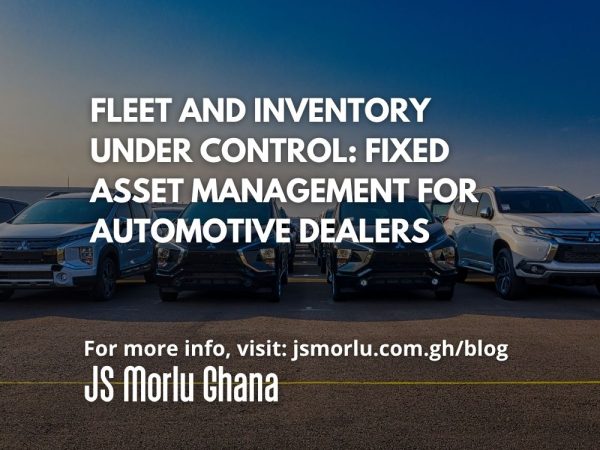
A vehicle sitting on a dealership lot may represent a sale waiting to happen, while another vehicle parked just a few metres away may be a business asset that supports daily operations. Treating both in the same way can create problems with records, depreciation, stock valuation, insurance, maintenance, and ultimately profitability.
For automotive dealers, effective asset management is therefore not simply about keeping a list of vehicles and equipment. It is about knowing what the business owns, what it holds for sale, what it uses to operate, where each asset is located, what condition it is in, and what it is worth.
A dealership may have vehicles for sale, demonstration vehicles, service vehicles, workshop equipment, office equipment, property improvements, spare parts, and other operational assets. Each category requires appropriate controls.
Understanding What Counts as Inventory and What Counts as a Fixed Asset
One of the first controls an automotive dealer should establish is a clear distinction between inventory and property, plant and equipment.
Vehicles purchased specifically for resale in the ordinary course of business are generally treated as inventory. Their value is connected to the dealership’s sales cycle rather than long-term use by the business. Under IAS 2, inventories are measured at the lower of cost and net realisable value.
By contrast, a vehicle used by the dealership for administration, customer demonstrations, deliveries, inspections, or other operational purposes may fall within property, plant and equipment, depending on its intended use and the applicable accounting framework.
IAS 16 applies to tangible assets held for use in the production or supply of goods or services, for rental, or for administrative purposes, when they are expected to be used for more than one period.
This distinction has practical consequences. If a vehicle intended for operational use is incorrectly treated as resale inventory, depreciation and asset values may be misstated. If vehicles held for sale are incorrectly capitalised as fixed assets, the dealership’s inventory and cost of sales can also be distorted.
The accounting classification should therefore reflect the vehicle’s intended use, not simply its physical location.
Build a Complete Asset Register
A dealership should maintain a central asset register covering its operational assets.
For vehicles, useful information includes:
- Vehicle identification number (VIN)
- Registration number
- Make and model
- Purchase date
- Acquisition cost
- Location or branch
- Assigned department or user
- Current mileage
- Insurance information
- Service history
- Warranty information
- Useful life
- Depreciation method and accumulated depreciation
- Current carrying amount
- Disposal status
The same principle applies to workshop equipment, diagnostic machines, generators, computers, office equipment, furniture, and other significant assets.
A complete register makes it easier to answer basic but important questions: Where is the asset? Who is responsible for it? How much did it cost? What condition is it in? Has it been serviced? Has it been disposed of?
Without this information, management may be making decisions using incomplete records.
Track Vehicles Individually
Vehicle inventory requires tighter controls than a simple stock count because each vehicle is individually identifiable and can carry significant financial value.
A dealership should be able to trace every vehicle from acquisition through preparation, storage, demonstration, sale, and final handover.
For example, suppose a dealer purchases ten vehicles for resale. One vehicle is moved to another branch, two are sent for detailing, one is used temporarily for demonstrations, and another is involved in a minor accident.
If movements are not recorded promptly, the stock system may still show all ten vehicles as being in their original condition and location. That creates an inaccurate picture of available inventory and increases the risk of loss, duplicate records, unauthorised use, or incorrect sales reporting.
Vehicle identification should therefore be supported by physical verification. Periodic counts should reconcile the VINs and registration details on the ground with the accounting or inventory system.
Do Not Ignore Ageing Inventory
A vehicle does not necessarily become worthless simply because it remains unsold. However, prolonged holding can reduce its economic value.
A vehicle may become less attractive as newer models enter the market. Its mileage may increase if used for demonstrations. Storage, insurance, maintenance, financing, and security costs may continue while the vehicle remains unsold.
This is why dealerships should monitor inventory ageing.
Management reports can group vehicles by how long they have remained in stock, such as:
- 0 to 30 days
- 31 to 60 days
- 61 to 90 days
- More than 90 days
The purpose is not merely to produce another report. Ageing information helps management identify vehicles that may require pricing review, targeted marketing, transfer to another branch, or other action.
Under IAS 2, inventory may need to be written down when its net realisable value falls below cost.
Control Demonstration and Company Vehicles
Demonstration vehicles create a particular control challenge because they may move frequently between sales staff, customers, workshops, branches, and events.
Every movement should have a documented purpose and responsible person.
A simple vehicle movement process can record:
- Date and time the vehicle leaves.
- Driver or responsible employee.
- Destination.
- Purpose of the trip.
- Starting and ending mileage.
- Fuel level.
- Vehicle condition.
- Expected return time.
- Any damage or incident.
This creates an accountability trail without unnecessarily complicating daily operations.
The same principle should apply to company vehicles assigned to management, sales teams, service personnel, or delivery operations.
Depreciation Is More Than an Accounting Exercise
For operational vehicles and other fixed assets, depreciation allocates the depreciable amount over the asset’s useful life. IAS 16 requires the depreciable amount to be allocated systematically over the useful life, with useful life and residual value reviewed at least at each financial year-end.
For automotive dealers, this matters because vehicles and equipment can experience substantial wear and technological obsolescence.
A dealership should therefore avoid simply applying arbitrary useful lives without considering how assets are actually used. Factors such as mileage, operating conditions, maintenance practices, technological changes, and expected disposal values can affect management’s estimates.
Depreciation should also begin when an asset is available for use, rather than simply when management happens to start using it regularly.
Accurate depreciation gives management a more realistic picture of the carrying value of operational assets and supports better replacement planning.
Control Workshop Equipment and Spare Parts
Fixed asset management should extend beyond vehicles.
Dealership workshops can contain expensive diagnostic equipment, lifts, compressors, wheel alignment machines, tools, generators, and specialised equipment. Smaller items may also be vulnerable to loss because they are frequently moved or shared.
Spare parts require a separate inventory control process. High-value parts should have clear identification, storage locations, issue records, and periodic counts.
Not every spare part should automatically be classified as a fixed asset. IFRS guidance recognises that spare parts, stand-by equipment, and servicing equipment are treated as property, plant and equipment when they meet the definition of PPE; otherwise, they are classified as inventory.
This makes proper classification important from the beginning rather than waiting until year-end.
Reconcile Physical Assets With Financial Records
An asset register is only useful when it agrees with reality.
Dealerships should conduct periodic physical verification and investigate differences rather than simply adjusting the records to match the count.
For example, if the register shows five diagnostic machines but only four can be located, management should determine whether the fifth machine was:
- Transferred to another branch
- Sent for repair
- Sold
- Written off
- Misplaced
- Recorded incorrectly
The investigation provides more value than simply correcting the spreadsheet.
For financial reporting, IAS 16 also requires information about property, plant and equipment, including measurement bases, depreciation methods, useful lives or rates, and movements in carrying amounts.
Introduce Clear Responsibility
Asset control becomes weaker when everyone is responsible and, in practice, no one is.
Dealerships should assign responsibility according to the nature of the asset. A fleet manager may oversee company vehicles, a workshop manager may control equipment, and finance may maintain the accounting records.
However, responsibility for physical custody and responsibility for accounting records should not necessarily rest with the same person.
Segregating duties can reduce the risk that an employee can acquire, move, use, sell, and remove an asset without adequate review.
Use Technology Where It Solves a Real Problem
A dealership does not necessarily need an expensive asset-management platform to improve control. The priority should be reliable information and consistent processes.
Depending on the size of the business, controls can include:
- Barcode or QR-code identification
- VIN-based vehicle records
- Digital inspection forms
- Automated service reminders
- Mileage tracking
- Inventory ageing reports
- Asset movement approvals
- Electronic document storage
- Scheduled physical verification
- Integration between inventory and accounting systems
Technology is most useful when it reduces gaps between what happens physically and what appears in the records.
Make Asset Information Part of Management Decisions
Good asset management should support decisions, not merely satisfy an accounting requirement.
Management should regularly ask:
- Which vehicles have been in stock too long?
- Which operational vehicles are becoming expensive to maintain?
- Which assets are underused?
- Which equipment needs replacement?
- Are recorded assets physically present?
- Are damaged or obsolete assets still carried at inappropriate values?
- Which branches have unusually high losses or asset movements?
- Are maintenance costs increasing for particular vehicles?
These questions connect asset records to cash flow, profitability, operational efficiency, and risk.
Conclusion
For automotive dealers, fixed asset management and inventory control are closely connected to everyday business performance. Vehicles for resale must be tracked as inventory, while operational vehicles and equipment require appropriate fixed asset controls, depreciation, maintenance records, and physical verification.
The practical objective is simple: the dealership should know what it owns, what it holds for sale, where those assets are, who is responsible for them, what condition they are in, and how their values are changing.
When these controls are consistently maintained, management has a clearer basis for pricing, purchasing, replacement, maintenance, financial reporting, and loss prevention. Asset management then becomes more than record-keeping. It becomes part of how the dealership protects its capital and manages its operations.