
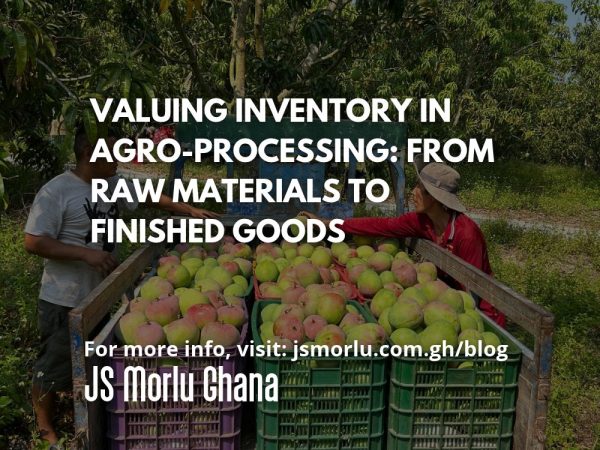
An agro-processing business may purchase tonnes of raw materials, process them into finished products and distribute them to retailers, wholesalers or consumers. However, the cost of producing those goods is not limited to what the business pays farmers or suppliers for the raw materials.
Storage, transportation, labour, processing, packaging and other production costs all contribute to the value of inventory. If these costs are not properly identified and allocated, the business may report inaccurate inventory values, miscalculate its cost of sales and overstate or understate its profits.
For agro-processors in Ghana, where production may involve seasonal harvests, fluctuating raw material prices, spoilage and different stages of processing, accurate inventory valuation is particularly important. Businesses need to understand how to account for raw materials, work in progress and finished goods as they move through the production process.
1. Understand the Different Types of Inventory
Inventory in an agro-processing business changes as raw materials move through production. Each stage has different accounting considerations.
- Raw materials: These are agricultural products and other inputs purchased for processing. Examples include cocoa beans, maize, cassava, palm fruits, shea nuts, tomatoes and packaging materials.
- Work in progress: These are goods that have entered the production process but are not yet ready for sale. For example, cassava that has been peeled, grated and partially processed into flour may still require drying, milling and packaging.
- Finished goods: These are products that have completed production and are ready for sale. Examples include packaged gari, palm oil, processed cocoa products, bottled fruit juice and packaged flour.
This distinction matters because each category represents a different stage of investment. A business that records all inventory as raw materials may fail to capture the additional costs incurred during processing.
Separating inventory into these categories helps management understand how much capital is tied up at each production stage. It also makes it easier to identify delays, excessive work in progress and finished goods that are not moving quickly enough.
2. Determine the Cost of Raw Materials Correctly
The first stage of inventory valuation is determining the cost of raw materials purchased for production.
Under International Accounting Standard 2 (IAS 2), Inventories, the cost of purchase includes the purchase price, import duties and other taxes that are not recoverable, transportation, handling and other costs directly attributable to acquiring the inventory. Trade discounts, rebates and similar deductions are excluded from the purchase cost.
For an agro-processing company purchasing maize from farmers, the cost may include:
- The amount paid to farmers or suppliers.
- Transportation from farms or collection centres.
- Loading and unloading charges.
- Non-refundable taxes and applicable duties.
- Other directly attributable costs of bringing the materials to their present location and condition.
For example, a processor purchases maize for GH₵80,000 and incurs GH₵5,000 in transportation and GH₵2,000 in handling costs. Assuming these costs qualify under IAS 2, the total cost of the raw materials is GH₵87,000.
However, not every expense associated with purchasing or handling agricultural products should be included in inventory cost. Abnormal wastage, unnecessary storage costs and unrelated administrative expenses are generally excluded.
Accurate raw material costing helps the business understand the actual investment required to secure the inputs needed for production. It also provides a more reliable basis for calculating production costs and setting selling prices.
3. Account for Processing Costs and Work in Progress
Raw materials become more valuable as they move through production, but this increase must be supported by the costs incurred in converting them into finished products.
IAS 2 requires inventory conversion costs to include costs directly related to production, such as direct labour, as well as a systematic allocation of fixed and variable production overheads.
In an agro-processing business, conversion costs may include:
- Direct labour: Wages paid to employees directly involved in sorting, cleaning, peeling, grinding, drying, cooking, pressing or packaging agricultural products.
- Variable production overheads: Costs that change with production activity, such as certain processing supplies, fuel and utilities consumed during manufacturing.
- Fixed production overheads: Costs that generally remain relatively stable despite changes in production volume, such as factory rent, depreciation of production machinery and factory management salaries.
These costs should be allocated systematically to the goods being processed.
For example, a palm oil processor may purchase palm fruits and incur additional costs for sorting, sterilisation, digestion, pressing, clarification and packaging. The cost of the palm fruits alone does not represent the total cost of the resulting finished product. The qualifying labour and production overheads must also be considered.
Work in progress should reflect the production costs incurred up to the reporting date. If some batches are only partially processed, the business should ensure that the costs recorded reflect their actual stage of completion.
This prevents inventory from being valued as though all goods have completed production when some still require additional processing.
4. Choose an Appropriate Inventory Costing Method
Agro-processing businesses often purchase raw materials at different prices throughout the year. Seasonal supply changes, transportation costs and market conditions can cause the cost of agricultural inputs to fluctuate.
IAS 2 permits two main cost formulas for interchangeable inventory: First-In, First-Out (FIFO) and weighted average cost. The specific identification method is used for inventory that is not ordinarily interchangeable or for goods and services produced and segregated for specific projects.
First-In, First-Out (FIFO): This method assumes that the inventory purchased or produced first is sold or used first.
For example, if a processor purchases maize at GH₵4,000 per tonne in January and GH₵4,500 per tonne in February, FIFO assumes that the January stock is used first, provided the inventory is interchangeable.
Weighted average cost: This method calculates an average cost using the total cost of available inventory divided by the total quantity available.
Suppose a business purchases 100 tonnes of cassava at GH₵2,000 per tonne and another 100 tonnes at GH₵2,400 per tonne.
The weighted average cost is:
Total cost = GH₵200,000 + GH₵240,000 = GH₵440,000.
Total quantity = 200 tonnes.
Weighted average cost = GH₵440,000 ÷ 200 = GH₵2,200 per tonne.
The business can use this average to value issues of inventory and remaining stock, applying its chosen periodic or moving-average approach consistently.
The method selected should reflect the nature of the inventory and be applied consistently to inventories with a similar nature and use. Businesses should not switch methods simply to achieve a preferred profit figure.
5. Account for Spoilage, Wastage and Storage Losses
Agricultural products are particularly vulnerable to deterioration. Raw materials may lose quality because of moisture, pests, poor storage conditions, contamination or delays in processing.
For agro-processors, these losses can affect both the quantity and value of inventory.
IAS 2 requires abnormal amounts of wasted materials, labour or other production costs to be recognised as expenses in the period in which they are incurred. Normal production losses may be reflected in the cost of the remaining output, depending on the production process.
For example, a tomato processor may purchase 10 tonnes of tomatoes but lose part of the quantity because some are damaged or unsuitable for processing. The business should distinguish normal losses associated with the production process from abnormal spoilage caused by poor handling or storage.
This distinction matters because treating all losses as normal production costs could increase the reported value of finished goods and conceal operational inefficiencies.
Businesses should maintain records of quantities received, quantities issued to production, expected production yields, actual output and wastage. Regular stock inspections can help identify unusual losses before they become significant.
Storage costs also require attention. Ordinary storage costs are generally excluded from inventory cost unless storage is necessary in the production process before a further production stage. For example, storage that is an essential part of the processing cycle may qualify, while general warehousing of finished goods before sale is normally expensed.
6. Apply the Lower of Cost and Net Realisable Value
One of the important requirements of IAS 2 is that inventory must be measured at the lower of cost and net realisable value (NRV).
Net realisable value is the estimated selling price in the ordinary course of business, less the estimated costs of completion and the estimated costs necessary to make the sale.
This requirement is particularly relevant to agro-processing businesses because agricultural products and processed goods can lose value quickly.
For example, a company holds packaged fruit juice with a recorded cost of GH₵50,000. Due to a shorter remaining shelf life, the company estimates that the products can now be sold for GH₵44,000 and will incur GH₵2,000 in additional costs to complete and sell them.
The net realisable value is:
GH₵44,000 − GH₵2,000 = GH₵42,000.
Since the NRV of GH₵42,000 is lower than the recorded cost of GH₵50,000, the inventory should be written down by GH₵8,000.
This ensures that inventory is not reported at an amount higher than the business expects to recover from selling it.
Agro-processors should review inventory for expired products, damaged packaging, contamination, declining market prices and other conditions that may reduce the amount recoverable from sales. NRV should be reassessed in subsequent reporting periods, and a previous write-down may be reversed when the circumstances that caused it no longer exist, subject to the limits in IAS 2.
7. Maintain Accurate Inventory Records Across Production
Accurate inventory valuation depends on reliable records. A business cannot calculate the correct cost of finished goods if it does not know how much raw material was purchased, how much entered production and how much was lost or converted into saleable products.
Agro-processing businesses should maintain records covering:
- Quantities and costs of raw materials received.
- Supplier details and purchase documentation.
- Materials issued to each production batch.
- Labour and production overheads.
- Work-in-progress quantities and completion stages.
- Finished goods produced and transferred to storage.
- Spoilage, wastage and stock adjustments.
- Sales, returns and closing inventory balances.
Production and finance teams should work together to ensure that physical stock movements agree with the accounting records. Periodic stock counts can help identify differences between recorded quantities and actual inventory.
A cloud-based accounting and financial management platform such as FinovatePro provides a central place to record transactions, track expenses and review financial reports. Its inventory management capabilities support the tracking of inventory quantities and values, including raw materials and finished goods.
For agro-processors, organised inventory and financial information can help management review stock levels, monitor costs and assess the financial performance of production activities. Businesses should also confirm that their inventory system supports the batch-level costing, production tracking and wastage records required for their operations.
8. Use Inventory Valuation to Support Better Business Decisions
Inventory valuation is not only a financial reporting requirement. It provides information that management can use to improve purchasing, production and sales decisions.
When raw material costs are accurately recorded, management can assess whether supplier prices are increasing and how those changes affect production costs. When work in progress is monitored, production managers can identify delays and determine whether materials are being processed efficiently.
Accurate finished goods valuation also helps management understand the cost of products available for sale and assess whether selling prices provide adequate margins.
For example, a cassava processor may discover that transportation, drying and packaging costs have increased significantly, even though the purchase price of cassava has remained relatively stable. Without proper cost allocation, the business may continue selling its products at prices that no longer cover the full cost of production.
Regular inventory reviews help management identify these changes and adjust purchasing, production and pricing decisions accordingly.
Conclusion
Inventory valuation in agro-processing requires careful attention at every stage, from the purchase of raw agricultural materials to the completion and sale of finished products. Businesses must account for qualifying purchase costs, allocate conversion costs appropriately, select a consistent costing method and recognise spoilage and inventory write-downs where necessary.
Applying IAS 2 correctly helps ensure that inventory values, cost of sales and reported profits reflect the actual costs and recoverable value of goods held by the business.
Accurate records also give management better visibility into raw material consumption, production costs and stock levels. With organised accounting and inventory information, agro-processors can make more informed decisions about purchasing, production and pricing.
Book a demo of FinovatePro to explore its accounting, inventory management and financial reporting capabilities and see how they can help your agro-processing business organise inventory records and monitor stock values.