
Ghana’s Infrastructure Reality and the Cost of Logistics
“In Ghana, Google Maps gives directions. The rain gives final approval.”
That may sound like a joke.
But for many businesses operating in Ghana, it is also operational reality.
A delivery scheduled for 10:00 AM can suddenly become:
- 1:00 PM,
- tomorrow morning,
- or “the driver is trying.”
Not because the business failed.
Not because the driver was lazy.
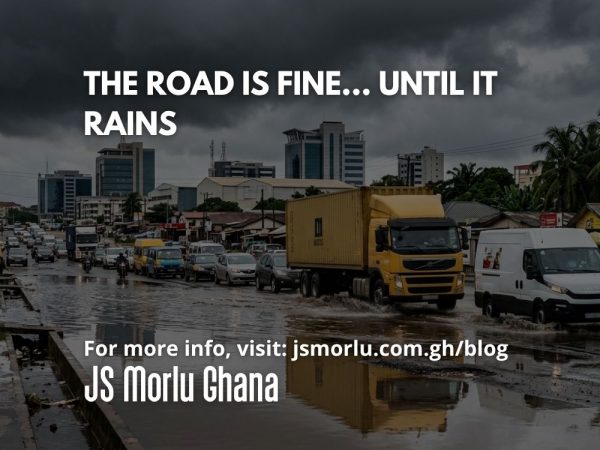
But because one heavy rainstorm in Accra can temporarily transform perfectly normal roads into emotional experiences.
Welcome to logistics in Ghana.
The Real Cost of Moving Goods
Many international companies entering Ghana focus on:
- taxes,
- labor costs,
- market opportunities,
- and customer demand.
What they often underestimate is movement.
The simple act of moving:
- products,
- inventory,
- equipment,
- fuel,
- and people
across a city can become one of the largest hidden operational costs in business.
Because in Ghana, logistics is not just transportation.
It is strategy.
Accra Traffic Is a Full-Time Business Partner
Accra traffic has reached a level where some workers spend more time commuting than attending meetings.
Two locations that look “close” on a map can emotionally feel like international travel during rush hour.
A truck carrying goods may face:
- traffic congestion,
- flooded roads,
- stalled vehicles,
- poor drainage areas,
- road construction,
- and fuel-consuming delays.
Every extra hour on the road quietly increases:
- fuel costs,
- maintenance expenses,
- delivery delays,
- overtime,
- and customer frustration.
Meanwhile, the delivery driver is somewhere sending voice notes saying:
“Boss, the road is bad.”
That sentence alone has delayed thousands of business operations across the country.
Rain Changes Everything
Ghana’s rainy season introduces a completely different operating environment.
Roads that function normally at 9:00 AM can become difficult by 4:00 PM after a heavy downpour.
Flooding affects:
- delivery schedules,
- inventory movement,
- warehouse access,
- retail operations,
- and customer traffic.
Some businesses do not monitor weather forecasts for convenience anymore.
They monitor them for survival.
Because one storm can disrupt:
- supply chains,
- store operations,
- distribution routes,
- and same-day delivery promises.
This is especially critical for:
- FMCGs,
- pharmacies,
- cold-chain logistics,
- manufacturers,
- and import/export businesses.
The Vehicle Is Suffering Quietly
Many companies underestimate how quickly difficult road conditions destroy vehicles.
Potholes, uneven roads, stop-and-go traffic, flooding, and heavy cargo loads create constant wear and tear.
That means:
- higher maintenance costs,
- more tire replacements,
- suspension damage,
- increased fuel consumption,
- and shorter fleet life cycles.
Some delivery vans in Ghana deserve therapy.
The vehicle may survive the road physically…
but spiritually, it has seen things.
Port Delays Affect Everything Downstream
For import-dependent businesses, logistics challenges do not begin in the city.
They often begin at the ports.
Even small delays in clearing goods can trigger:
- inventory shortages,
- production slowdowns,
- delayed customer deliveries,
- and working capital pressure.
A shipment delayed for several days can affect an entire supply chain cycle.
And once delays begin, businesses start making expensive decisions:
- emergency sourcing,
- rush transportation,
- higher storage costs,
- and reactive inventory purchases.
That is how logistics problems quietly become financial problems.
Inventory Management Becomes More Complicated
In highly predictable environments, businesses can operate with lean inventory systems.
In less predictable environments, companies often hold more stock “just in case.”
That creates another challenge:
- higher warehousing costs,
- tied-up cash flow,
- inventory aging,
- and forecasting difficulties.
Some businesses in Ghana are not carrying extra inventory because they want to.
They are carrying extra inventory because uncertainty demands it.
Ghana Still Offers Massive Opportunity
Despite these realities, Ghana remains one of the most attractive business destinations in West Africa.
Why?
Because businesses here have developed extraordinary adaptability.
Ghanaian companies know how to:
- improvise,
- reroute,
- negotiate,
- adjust,
- and continue operating under pressure.
That resilience is valuable.
But smart businesses also understand something important:
Operational resilience should not replace operational planning.
The companies that succeed long-term are the ones that:
- plan for disruptions,
- invest in logistics strategy,
- strengthen inventory systems,
- optimize distribution,
- and build realistic delivery models.
Final Thought
Infrastructure does not just affect transportation.
It affects:
- profitability,
- customer trust,
- operational efficiency,
- pricing,
- and growth.
The road may look fine in the morning.
But in Ghana…
the rain always gets a vote.