
By: Bernard Bempong, CA
“In Accra, a 15-minute meeting requires a 2-hour emotional commitment.”
That statement sounds dramatic until you actually live in Accra.
Then suddenly it becomes:
- strategy
- scheduling
- survival planning
- and sometimes spiritual warfare
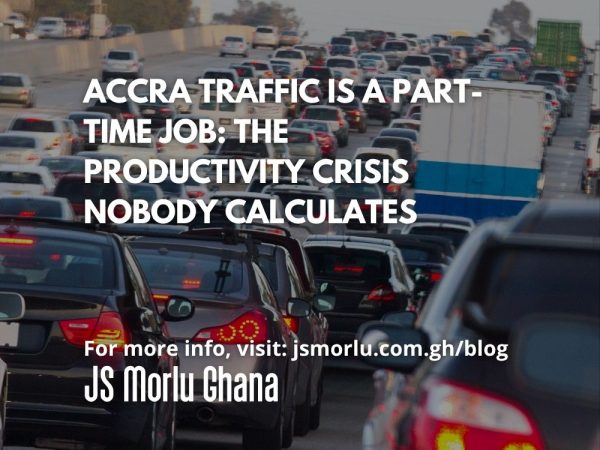
Because in Accra, traffic is not merely transportation. It is an economic force. A lifestyle. A daily negotiation between hope and reality.
The Commute Before the Actual Work
Many employees in Accra wake up extremely early not because they are ambitious…
but because they are afraid.
Afraid of:
- gridlock
- flooded roads
- broken-down vehicles
- impatient drivers
- surprise congestion
- and watching a 20-minute journey become a 2-hour documentary
By the time some workers arrive at the office:
- mentally exhausted
- emotionally drained
- and dehydrated
they have already completed what feels like one full shift
The actual workday has not even started yet.
Traffic Quietly Destroys Productivity
Most companies calculate:
- salaries
- office rent
- internet
- fuel
- and utilities
But few calculate the hidden cost of traffic.
Traffic affects:
- meeting schedules
- delivery times
- customer response rates
- employee energy
- decision-making speed
- and operational efficiency
When employees spend several hours daily trapped in traffic, businesses quietly lose:
- productive work hours
- focus
- creativity
- responsiveness,
- and morale
The damage happens slowly enough that many organizations normalize it. But normalized inefficiency is still inefficiency.
Fuel Consumption Becomes Financial Bleeding
Traffic turns fuel into a recurring emotional expense.
Vehicles spend large portions of the day:
- idling
- inching forward
- braking
- accelerating
- and suffering mechanically
This increases:
- fuel costs
- maintenance expenses
- engine wear
- tire replacement
- and fleet operating costs
Some company vehicles in Accra burn fuel aggressively while accomplishing almost nothing geographically. The car moved three kilometers. Financially, it traveled to sadness.
Delivery Timelines Become Fiction
Traffic also creates serious logistics challenges.
Businesses trying to manage:
- deliveries
- customer pickups
- distribution schedules
- field operations
- and fleet coordination must constantly adjust expectations.
A driver leaving at 10:00 AM may arrive:
- at 11:30
- 1:00
- or “the driver is almost there”
In Ghana, “almost there” is not always a location.
Sometimes it is a motivational statement.
This unpredictability affects:
- logistics firms
- e-commerce businesses
- FMCGs
- banks
- telecom companies
- and service providers
Customers become frustrated.
Employees become stressed.
Operations become reactive instead of efficient.
Employee Burnout Is Real
Traffic does not only waste time. It affects mental health too.
Long commutes increase:
- stress
- fatigue
- irritability
- poor sleep
- and burnout
Some workers leave home before sunrise and return after dark.
Over time, this reduces:
- engagement
- concentration
- patience
- and workplace satisfaction
Then management wonders why productivity is dropping while everyone looks emotionally defeated by Wednesday afternoon.
The employee is not lazy. The employee fought traffic for three hours before opening Outlook.
Hybrid Work Is No Longer a Luxury Discussion
Globally, hybrid work discussions often focus on:
- flexibility
- workplace culture
- and employee preferences
In Accra, hybrid work increasingly becomes an operational efficiency conversation.
Because sometimes the most productive employee is the one not trapped in traffic.
Businesses are slowly realizing:
- fewer unnecessary commutes
- smarter scheduling
- remote collaboration
- and decentralized operations can significantly improve productivity
Not every meeting requires:
- 14 people
- two conference rooms
- and four hours of transportation suffering
Some meetings could have simply been: “Please see attached.”
Fleet Management Has Become Strategic
Companies operating vehicle fleets in Accra now face increasingly complex operational decisions.
Fleet management is no longer just:
- buying vehicles
- assigning drivers
- and paying for fuel
It now involves:
- route optimization
- delivery timing
- maintenance planning
- driver monitoring
- fuel controls
- and operational analytics
Because poor traffic planning creates direct financial consequences. The companies that manage logistics intelligently often outperform competitors quietly. Not because they work harder. Because they waste less time.
Accra’s Energy Is Still Remarkable
Despite the traffic, Accra remains one of Africa’s most energetic and commercially vibrant cities.
People still:
- hustle
- build businesses
- launch startups
- negotiate deals
- and create opportunities every single day
That resilience is extraordinary. But resilience should not blind businesses to operational realities. Traffic is no longer simply an inconvenience. It is a measurable business variable.
Final Thought
The true cost of traffic is not just fuel.
It is:
- lost productivity
- delayed decisions
- exhausted employees
- operational inefficiency
- and reduced economic output
In many companies, traffic quietly shapes:
- scheduling
- profitability
- customer experience
- and workplace morale
And in Accra…
A calendar invitation at 2:00 PM is not just a meeting. It is a transportation strategy.
Author: Bernard Bempong is a Chartered Accountant and business advisory leader with over 14 years of experience in audit, taxation, financial management, operational strategy, and business advisory services. As Managing Director of JS Morlu Ghana, he advises organizations on operational efficiency, governance, risk management, and sustainable business growth across multiple industries.